Yesterday I went by a music store. I wasn't really looking for something, just checking if there were good CDs at a good price. And then I saw this:
I don't know if this was made on purpose by an employee with a witty sense of humor or just is the result of a decreasing demand in both genres, which makes possible to toss all the CDs with those themes in just one sector. Whatever it was, it certainly was appropriate.
Well, today is the actual Ash Wednesday. So, here is Ash
looking badass
And here is Wednesday
The original goth. The rest are just emo
But further than that, if you're a person with a pretty wide social circle, you then know at least a couple of devote Christians, which you will recognize by the dirt on the forehead they'll bear today. So what's that about?
As you might know, Jesus supposedly spent 40 days in the dessert just hanging around alone (his friends say fasting, but when you're the Son of God, you can pretty much have a cheeseburger appear, brought by a Hooters girl). During this time, Satan is said came to troll him. He offered lots of cool things, but Jesus said no way Jose. Satan then thought about it and just left saying "dude, I just realized no trolling I'll ever do will be compared to your own holy old man letting you being accused, beaten, whipped, raped and killed to atone for others' faults, so, see ya later"
Well, Ash Wednesday marks the beginning of this 40 days. During this time, called Lent, many believers will pledge to abandon some kind of pleasure, trying to imitate Jesus fasting during those 40 days.
Or you can just give up sex for the sake of a bad comedy movie that ends up with the protagonist being raped.
The idea behind the ashes is to show sorrow for the sins committed. Along this, the fasting and penitence takes place, preparing the person for Easter. This is something quite hard to understand (or maybe, something that just needs to be done instead of understood), the idea that repentance should be done through self denial and visible actions towards God. Whatever we do, if we feel it's wrong, will most likely have a negative effect on others. And it is towards these others that our repentance shall go. It useless to look at the skies and say "God, forgive me" if nothing is done towards the ones who actually suffered from our actions.
We share this planet with others and if we expect to live a quiet happy life, it will be very helpful to have good relations with those who surround us; for our own sake not because God is telling us. As a non-believer I don't need a deity to tell me to be a good person. And if I wanted to be a bad person, well, I think I can find a justification in that same deity.
It's been brought to my attention that today is Cat Day 2011, and given the attraction the internet has with cats, it would be irresponsible not to do something.
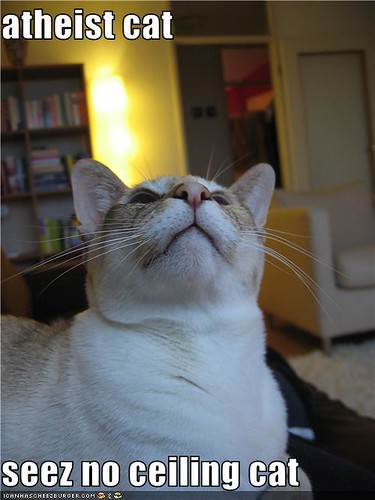
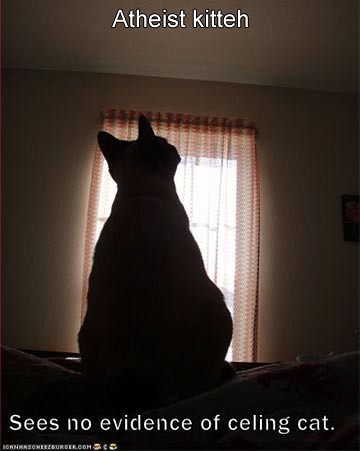
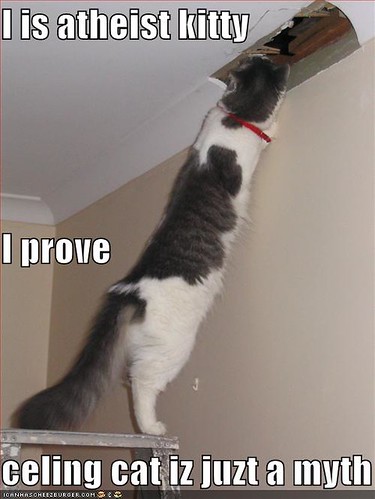
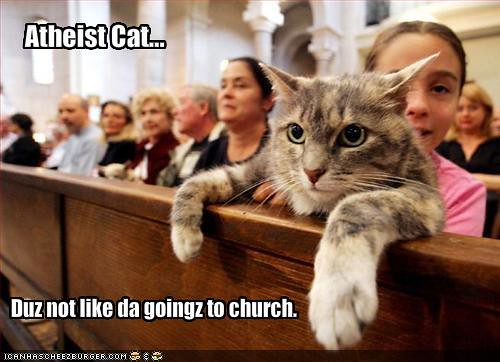
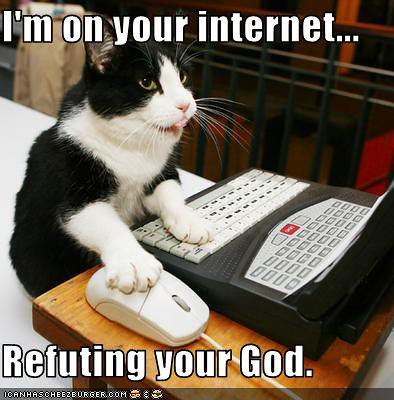
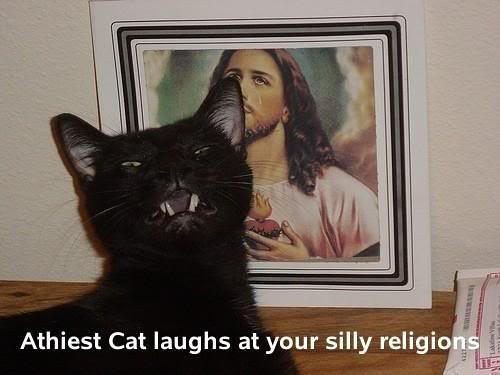
So, for your entertainment, here are the best atheist cats
That's ok, search is good. But eventually one has to accept that no matter how much you searched, or others have searched, there is none, and then start acting like there is non. But keep searching.
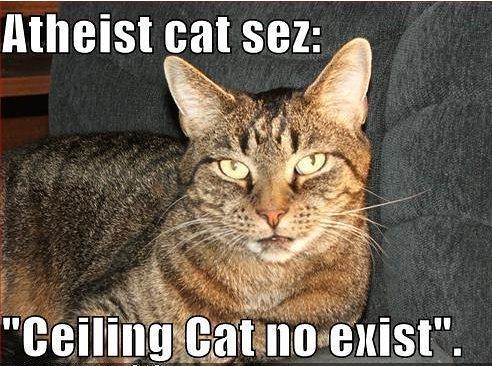
Yeah, no ceiling cat
Still, no proof of ceiling cat
No evidence of it.
Just like, Santa Claus. You want me to believe in it? Show proof.
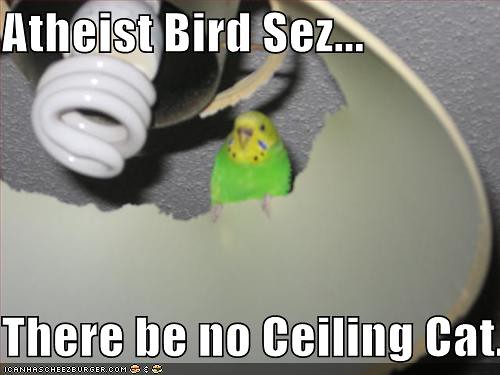
Even the bird says so.
Oh, and your images and concepts, no matter how cute and lovely they are (enough to send his "son") are no proof
Which, considering the evidence is a pretty accurate and practical conclusion.
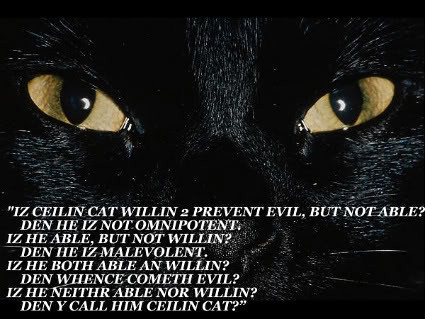
And even if he existed, he is pretty much a dick
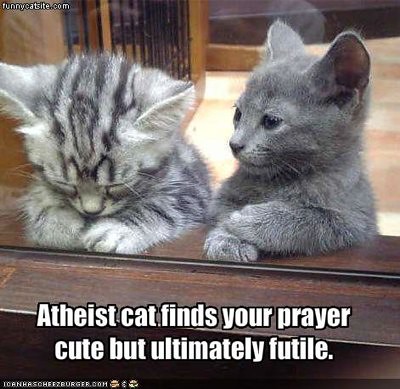
Your prayer, your songs, your paintings, architecture and art can be nice. But futile.
Which is why I prefer to use my time in other ways
Which is certainly more entertaining
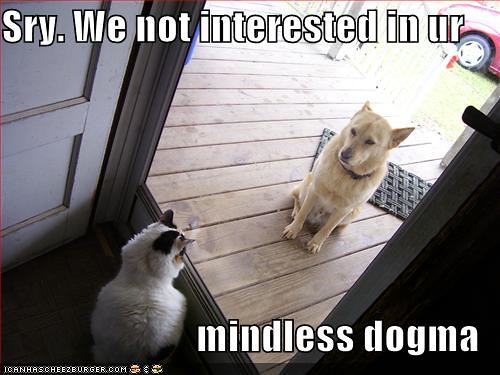
But sometimes I'll be bothered with people actually coming to my door and trying to convince of otherwise
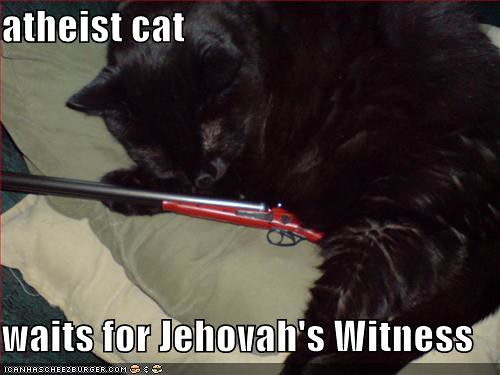
And if this doesn't stop
But there are other implications, such as the ignorance religion promotes, even after facing the overwhelming proof science give us.
Yeah, the only reason so many people like to think that is because of their beliefs and faith-based ignorance. For that I can not show respect. That's why
A couple of weeks ago (damn, it’s taken me so damn long to write this) the Southern California Secular Humanist Conference took place in San Diego. Well, this is kind of a long name for an atheist conference, but the idea, I guess, is to reunite all forms of lack of belief, and since today “atheist” is still sort of an alienating term, we have “secular humanist”. But that’s just a minor detail. I’m glad I went and had an awesome time.
My principal motivation to go was to meet Dan Barker. As most of you know (or should know), Barker was an evangelical preacher who even used to go to Mexico to convert Catholics into Protestants. However, one day he started to question his beliefs and after some time, he came out as an atheist. Today, he works for the Freedom From Religion Foundation.
Jason Frye Kolarik The conference started at 9 a.m. with a little introduction by Jason, who was the main organizer and one of the most powerful promoters of the atheist movement in the San Diego area. Jason works as president of the Humanist Association of San Diego and also as a “humanist minister” which means he acts as a minister in events that otherwise would need a priest or a pastor.
Just after Jason, came Berkshire, who is president of the Minnesota Atheists, and has worked as vice-president for Atheist Alliance International. Berkshire explained pretty well how it is not only that it is possible to be good without God, but also, necessary to put aside the “Bible morality”, which we have been doing for quite a long time in order to achieve progress. In other words, morality doesn’t come from God, but from our own conscience on how we value other human beings.
Stuart Bechman Bechman is the American Atheists director, and has also served in different atheist organizations. Bechman presented many of these organizations, and how they were hostile against each other at the beginning. However, according to Bechman, George W. Bush’s first term changed that, and then those secular organizations started working with each other in order to reach a common goal. I liked this concept, especially to be considered for secular associations that are just starting to try to make some kind of impact in their communities. Certainly more would be achieved if more groups worked together.
Judith Hand Hand is an ethologist and peace activist who talked about humanity’s goal for global peace, but from an evolution point of view. According to hand, since there have been movements to erradicate slavery and child labor, eventually we can make a movement against war, which is some kind of “evolutive defect”. Also, Hand is a prolific writer with many published books.
Roy Speckhardt Speckhardt was one of my favorite speakers. He is the American Humanist Association executive director, and during the conference, he talked about the different ways we consider ourselves. According to Speckhardt, atheists, agnostics, freethinkers, humanists, secularists, brights, etc, are just ways to describe ourselves with an emphasis in that which we emphasize the most. However, we are still part of those don’t believe in a god. He added that those who consider themselves with no religion are a growing group that should and will retake the United States to its secular roots by the year 2020.
And this goes along pretty much with how I see the atheist/secular/humanist/whatever movement. No matter what my purpose is, (which nature Dan Barker would later explain) is to contribute to build a better world for everyone, a world in which religion doesn’t mess with anyone’s life. To be involved in petty fights over what label we are using is just useless. Considering what Bechman said, atheists need to be organized and work together, more and better than what we are doing, in order to achieve our goals.
Debbie Skomer Skomer wasn’t exactly a speaker, but the receiver of an award, the Local Organizer Award, for all she did representing the secular humanist community in San Diego, especially regarding talking to the press.
Dan Barker As I said before, meeting Dan Barker was my main motivation for coming to this event. I had considered even going to Mexico for the Coloquio de Ateismo, but didn’t have my passport ready. So, as soon as I got to the conference I looked for him. There he was, talking to other like he was another one of us, not a renowned atheist activist. He was very nice and got to talk to him, even doing an interview in Spanish, for all the atheists who can relate to his story of leaving his faith after being a committed believer, me among them. I also bought a couple of his books, The Good Atheist (which is about our purpose in life) and Godless, which is about the journey from religion to reason. There is also an older book "Losing Faith in Faith: From Preacher to Atheist" which didn't seem to be available with Barker at that moment.
En su presentación, Barker hizo gala de sus dotes como músico, y nos cantó ya no una canción que hablara del amor de Dios y otras patrañas, sino de algo más animado y menos irracional.
After the songs, he talked about our purpose, which is the topic on his last book. Barker said that people have to find their own purpose in life, which usually involves fixing something they see unfit for the world. This purpose should be determined by the person and definitely not be thought as given by God, or more exactly, by anyone claiming to know what God wants from us.
As I said before, I can pretty much feel identified with Barker. I once was a devote believer and had no doubt that there was something God wanted from me. Happy I was, but delusional nonetheless. I’m happy I’m not in such state anymore and the only intolerance I can harbor goes toward intolerance itself.
David Diskin David Diskin is the organizer of Camp Quest West, which is a summer camp that, unlike many other around the US has no religious affiliation. The idea is not teach atheism to the kids, but to teach them how to reach answers with the correct tools. Certainly something very different from religious oriented camps, like this one:
Jason Torpy Torpy in an officer who serves as the President of the Military Association of Atheists and Freethinkers (MAAF). Torpy spoke about the stereotype that “there are no atheists in foxholes” but according to his data, those who express no religious affiliation are almost 1 in 4. Torpy also spoke about the ideal of engaging in dialogue before taking court actions, in which dialogue is not possible anymore. Legal actions should be taken only when there is no more room for dialogue.
James Croft Croft is a student at Harvard who talked about the atheist movement’s lack of symbols and traditions, which religion has lots of, and by lacking those, the atheist movement loses the kind of people who likes them. Croft pointed at a Cross and demonstrated how many emotions and ideas come associated with it, but that doesn’t happen very often with the atheist movement.
Bobbie Kirkhart Kirkhart serves as vice-president for the Secular Coalitoin of American, as well as serving as co-presiden for Atheists United. Kirkhart presented many prominent female activist within the secular movemente, proving false the idea that atheism is a field only for men. Kirkhart especially mentioned Ayaan Hirsi Ali and Dr. Eugenie Scott.
Ted Cox Cox was another of my favorite speakers. He talked about his experience undercover in religious groups that pretend to cure homosexuality through different therapies, which go from the utterly ridiculous, to the cruel and perverse. One of these therapies consisted of a man being touched, in a non-sexual way by other men, to provide the “manly love” in a good way that they supposedly lacked during their first years.
Bruce Gleason Gleason organizes “Backyard Skeptics in Orange County. It’s interesting to see a community of skeptics well formed and that provides a socializing place for non-believers in a certain area. Religion provides that sense of belonging to a community (in the same way a stamp-collecting club does) and it’s certainly a good idea for non-believers to have that too.
Roger Nygard Nygard is a film director and producer who presented his last film trailer, “The Nature of existence”, in which he travels around the world asking different people about the reason of our existence. Preachers, priests, Buddhists, Richard Dawkins and even wrestlers give him their opinion.
Now, at some break, an awesome piece of music came from the speakers. I went and asked the sound guy what was it, and he told me to ask the group who was performing, Ana Kefr, which is a metal band with an atheist theme. I went to them, bought their CD and told them they were awesome.
Sean Faircloth Faircloth is the very eloquent director of the Secular Coaliton of America, an also, ex congressman for Maine. Faircloth gave a pretty funny speech about how religious thinking hijacks legislation and morality, especially portraying sexuality as a big taboo and usually making things worse than they are. He also talked about how religion usually is in the way of human rights.
A really nice guy.
14. Brian Keith Dalton, a.k.a. Mr. Deity I don’t think there are many atheists who don’t know who Mr. Deity is. In case you don’t, well, Mr. Deity is an absent-minded deity (maybe God) that doesn’t seem to get what is wrong with his commandments and the way his people behave, even seeing nothing wrong with they stoning a woman for not being a virgin, or wiping entire towns..
Dalton made a comparison between holy books and cooking books, both of which take their followers to accept only one way to cool food and leading to disputes and violence.
With Mr. Deity and wife
15.Michael Newdow Newdow is an awesome guy. He graduated as a doctor, and then went to study law. After becoming a lawyer, he started suing against the references to God in the Pledge of Allegiance. Newdow arrived wit his family to receive the Phil Paulson Award for all he has done for a more secular. Instead of giving an award speech, Newdow sang a song, accompanied by Dan Barker. This could be called, The Separation of Church and State Song
Newdow was sitting in front of my table, along with his wife and two daughters. If I ever have children I would like to be as cool dad as Newdow is.
16. Jamy Ian Swiss As a grand finale, we had Jamy Ian Swiss, a magician and skeptic activist who through his tricks showed us how easy is to fool people. Swiss said that mediums, palm readers and other alike use the same methods, which are certainly not supernatural, to take advantage of their victims, usually when they are the most vulnerable.
I couldn’t record his presentation, since we had been explicitly told that nothing could be taped. If I weren’t a skeptic and Swiss would be making the case of having supernatural powers, I might have believed him. He got to know a word picked by a random person from a random book, with minimum details. Truly impressing stuff.
And that was it. After that I helped picking up some cables and joined other for the after party at the bar in the hotel. Faircloth was there, as well as James Croft and Jason Kolarik. I’m really glad I went to this conference and just sad it took me so long to write all this.
For more information about the "Virgin of Guadalupe" check Brian Dunning's Skeptoid, especially to this part:
The Virgin of Guadalupe is yet more one mythical story whose believers are missing out on true facts that are actually more respectful and confer more credit upon them than the myth. The image on the Virgin tilma was painted by a native Aztec artist; and the painting had not only an important role in Mexico's early history as a nation, but also a staggering impact upon its culture ever since. Mexicans with Aztec heritage should take pride in the fact that their original culture, specifically the goddess Tonantzin, was a key ingredient in the spread of modern Catholicism. The Juan Diego myth takes that away, and whitewashes part of Mexican history clean of any Aztec influence. That's a disservice to one of humanity's greatest ancient civilizations, and it's a disservice to history.
If you are aware of how politics run in the United States, then you certainly know who Stephen Colbert is
In case you don't know, Colbert is a satirist who parodies right-wing attitudes and criticizes them. Of course, he also takes on liberals sometimes, but conservatives tend to give more material for satire. Like this:
O'Reilly is obviously a moron and Colbert awesomely points that out. The argument of "I don't know how that works, therefore God must be behind it" is just taking pride in one's own stupidity and ignorance, using the later as an excuse to believe in God.
One would thing that, since Colbert criticizes religion so hard, he would be, at least, a non-believer. O'Reilly for example, is a Catholic.
I love my Church, and I'm a Catholic who was raised by intellectuals, who were very devout. I was raised to believe that you could question the Church and still be a Catholic. What is worthy of satire is the misuse of religion for destructive or political gains. That's totally different from the Word, the blood, the body and the Christ. His kingdom is not of this earth.
The first sentence will be puzzling for many, but it shouldn't be. Yes, there are Catholics who are pretty intelligent and won't go along with much of the non-sense that comes from The Vatican. After all, Catholics aren't as crazy as Evangelicals who support Intelligent Design.
The second sentence is kind of puzzling, since the Catholic Church is certainly not a democracy. It's teachings are supposed to be those of the very institution founded by Christ and should not be criticized. To pretend to criticize it, or disobey them, sounds a little bit hypocritical. Yet, if that leads to a more open, liberal and democratic Catholic Church, then might be ok.
The last sentences have two sides that are worth mentioning. First, Colbert criticizes the use of religion for "bad" things, like gaining power or destroying others. That sounds nice. However, it's up to Colbert to make such judgment. But that's not what the leaders of the church think. That's not what the Vatican thinks. It's hatred of gays and atheists, and the destruction of life that comes along with a policy against condoms make it pretty obvious.
No religion has the monopoly of goodness, so it's wrong to assume that whatever is bad is opposed to the word of God. The Bible has been interpreted by many in very different ways, both to do wrong and right. But all of them claim to have the correct interpretation.
Finally, I like watching the Colbert Report. It's satire is impeccable. Colbert might think that there is a kingdom for the afterlife, which is ridiculous, but as long as he keeps that himself, no problem with me.
Remember the Simpson's episode in which Homer finds out there is no God and when Flanders is shown proof of it, he dismisses it and prefers keep with his beliefs?
Believers' capacity to deny reality never ceases to amaze me. It's not even as if we didn't know about these facts, but that they don't like the facts just because they belittle their petty God. Well, as Einstein said, "Only two things are infinite, the universe and human stupidity, and I'm not sure about the former"
Yes, the title is a reference to that movie that just came out, I think, last weekend. Yes, I know, it was kind of silly, but had lots of geek references that made it funny. Also, I had a cute girl with me, so it was a good time.
So, yes, I enjoyed the movie. However, the guys from CBN (Christian Broadcasting Network) didn’t
First of all, let us know who are those talking. CBN is a network founded by one of the biggest Christian assholes, Pat Robertson, who is well know for blaming Haiti’s "pact with the Devil" for the quake they had at the beginning of the year. Focus on the Family on the other hand, is an organization founded by James Dobson, which purpose is to “nurture and defend the God-ordained institution of the family and promoting biblical truths worldwide”, such as school prayer, corporal punishment, opposition to abortion, feminism, porn and gambling, and of course, demonization of homosexuality.
Ok, so we know the sponsors are world-class bigots. But let’s forget about that and pay attention to the message
The newscaster says “beware of the anti christian messages out there”. So, there must be some movies that say very clear that Christianity is a bad thing, or Christians are just mindless sheep, or stuff like that, right? Well, check it out:
Well, no. If you see what the “Plugged in” guy says, it’s all about the fact that Ramona (the main female character in Scott Pilgrim vs. the World) has had a girlfriend. Add to that, the fact that Scott’s roommate is gay.
Look at the far right. That was the problem
Apparently, that makes it unfit for 13-year olds, because, well, no 13-year old knows that gays and lesbians exist. Or, if they do, they should now that their way of loving is, wrong, evil, and, anti-christian.
I think I have stated it before, that I have no problem with people believing whatever they want to believe. The problem comes when “different” becomes “anti”; when “different” becomes the enemy. I might not care much if this were just one bigotted redneck talking in his mobile home, but that’s not the case.
We are talking about these views in a broadcasting network, with millions of people watching, founded by “respectable” members of our society, despite their bigoted and anti-scientific views. Yes, I say “anti scientific”, because, gays are not evil, Haiti’s quake had its origin in plaque tectonics and the Earth is not 6000 years old.
Then there are two other reviews that I don’t care much about. “Eat, Pray, Love” sounds like a chick-flick that doesn’t get my attention, but, by the comments of that guy, is “anti christian” because Julia Roberts tries to find the “divinity within herself”, and because it “asks the right questions” but answers them in the wrong way, meaning, not in the Christian way. Because, well, for these guys, anything that is not Christian, is anti-Christian. It’s “new agy” and that gets them worried, because someone might want to think differently. It says that we are “spiritually divine” and that is sad and scary, for these Christians. “An anti-christ message”
Please, wake me up when it's finished
Finally, “The Expendables”. Obviously, it’s not a family film, but apparently not even christian grown-ups should see it, since it receives a “thumbs down”. Maybe that “born again” thing leaves them being children forever. See how easy is for children to believe in Santa Claus, or the Tooth Fairy? Yeah, like that.
It’s very likely that you have heard someone, usually a person not very enlightened who thinks he/she can rationalize the issue in something that simple, say that atheism is a religion. Sometimes it’s hard to deal with it, given the obvious bullshit that has just been spewed at us, considering that “atheism”, meaning “belief in no god” would be equaled to a religion.
Something that comes to the mind of the non-believer who has heard that is the fact that believers usually say it with an intent to insult, as if having a religion were something bad. Well, don’t take it like that; what believers are doing is calling us “hypocrites” for criticizing their belief. Of course, the believer who does that, can’t understand that atheism by definition cannot be a religion.
Many things have been said about this, just like the example from the title. The Friendly Atheist even dedicated a post to the issue, but I can’t find. What he did is link to a video from that Youtube Demigoddes, ZOMGitsCriss. Here, see it for yourself.
Now, see it once again, because she is so hot you couldn’t pay attention to what really she said.
Ok. Cristina (her real name, if you didn’t know) answers to that religious guy who “can’t be talked away” from the idea that atheism is a religion. Cristina refutes each and everyone of his points.
What I want to do is something a little different. Every religion has certain elements that are common to every set of belief to qualify as such. I wrote about these “dimensions” earlier, and have been thinking about comparing them to atheism to see if it qualifies. So, let’s do it:
1. Ritual: Every religion has a ritual that must be followed. There 4 kinds of rituals, which are daily, weekly or monthly, yearly, and those of once in a lifetime. Daily are prayer or meditation, weekly are the mass or sabbath, yearly are Ramadan and Yom Kippur and once i na lifetime, marriage or visitation to Mecca.
Don't laugh! They are praying!
What about atheism? Does atheism has a ritual that must be followed? Deny God, or read atheist blogs once a day? Go to the natural museum every month? Go to awesome atheist conventions every year? Meet Richard Dawkins? Of course not. All that stuff, while cool, is just purely optional. The average non-believer will seldom show his unbelief unless asked or provoked. So, no, atheism has no rituals. Next!
2. Myth: Ok, wait, myth does not mean a “lie”, it means more like a “story”, or account of events, that might be true or false, and upon which religion is based. This story is sacred for people and usually tries to answer difficult questions like “where do we come from”, “where are we going to” and finally, the story of our group. If you are thinking about the Adam and Eve myth, you are correct. The early inhabitants of my country, Peru, would explain their existence by the Apu Kon Tiki Wiracocha myth
This is Viracocha. He came out from the Titicaca Lake, created everything (but don't ask how the lake was already there, it's disrespectful) and then made mankind by breathing into stones. He didn't like, destroyed them with a flood and created new ones. Then went away. Nice story, isn't it?
So, do atheists have a story, that they are unsure is real or not, that is sacred, and that answers those questions? Obviously, not. No, evolution does not qualify. It is not sacred, it is not millennial and certainly is not telling us anything absolute. What we know about evolution is knowledge we have gained through studies by scientist, that have been put to trial and debunked or accepted. Might not sound perfect, but it’s much accurate than “this is a story that we all consider sacred”. So, no, atheists don’t have myths. Next!
3. Doctrine: This one is about the core beliefs of the religion. Has a lot to do with that word believers like to use a lot: Truth. Truth, here, truth there, Jesus is the truth, They hate me for saying the truth. Don’t you want to punch them in the face when they do it? I know, but we are civilized people who put over our shoulders the task of showing that “water is composed of hydrogen and oxygen” is “truth” while “God created everything” is not.
So, the doctrine can be separated in three parts. Pay attention: - Theology, “Who gives the truth”: In many cases, God, a supernatural being. Sometimes it can also be a force, especially when talking about eastern religions. - Cosmology, “Where to find the truth”: Well, where do you think? In the fucking bible, where else? But you don’t get it just by reading, you also have to pray and “transcend”, because the bible is different from other books. - Soteriology: ”How to do what is truth”. Christianity, Islam and Judaism tell people they cannot help themselves, but need of God. So once they know how to do it, they must do it. On the other hand, Buddhists will say that people need to find they inner answer.
The Bible is the Truth because it is the word of God. We know it's the word of God because the Bible says it so; and we believe that because the Bible is the Truth.
Now, what about atheists? First of all, non-believers usually talk about “fact”, not “truth”, because we are not arrogant enough to say we know it all (well, we usually know more). Who gives the truth? No God, no “force”, no nothing. No one. There is just no “truth”, just what we find after investigating our surroundings. Where is the truth? The truth is out there and anyone, with enough money, time and studies can find it, if we are talking about scientific facts. And how do we do it? Well, by not doing what believers do. That’s what the “a” in “atheist” is for. Next!
4. Ethics: This one has to do with lifestyle, and how to be a good person or a bad person. Most of these “rules” will control money, sex and killing; commands (for example, the orthodox jews have more than 600 commands) and relationships with others. In other words, rules for almost everything
Those 2 commandments contain much more ethic than anything I've read from Christianity
Atheists and non believers tend to apply the “golden rule” as a way of knowing how to be a good or bad person. Also, scientific knowledge is applicable. Why support the gays in marrying? Because scientists say there is nothing wrong. To deny them such right is, well, to be an intolerant dick. Our "rules" tend to change according to the times in which we live. The society's ethics, as a whole, do that same thing. However, many religious people tend to stick to their outdated rules, even after facing the facts that prove those rules to be impractical, discriminatory and plain evil
5. Social life: Religion also have rules on how to behave with others inside or outside of the religion. They ask, what should be done with outsiders? Kill the infidels? Convert the unbelievers? Not give a shit about their behavior? Those kind of questions. It also addresses what to do with those inside. Who are the special people? The priests? The imams? What role do women have? Should we respect old people?
Atheists don’t have those kind of rules to treat different those who are or not unbelievers. We just treat everyone like an equal, and if not, well, it’s not like there is a written rule to do so. We tend to respect scientists, but not because they are something especial, but because they know something more than us and can show us what they know. Anyone can gain that knowledge, which is nothing especial. That is why we tend to cite them so often. They are not especial people chosen by someone, or with some kind of authority (other than scholar authority) over us. It's thanks to them that we understand reality. If we wanted to understand, let's say, laws, then we get a lawyer. Build a house? An engineer. Next!
6. Experience: It’s about what goes inside the person and what their feelings are. Religions have two kind of moments related to the sacred: “Mysticals” in which they feel great unity with god; and “Numinous” in which they fear it and understand how small they are.
In the US there is a prevalence for numinousity, understanding how little we are and how we can do more and never be content with what we have.
Then there is the “change” experience, which is the intensity of change: There are multiple births, in the idea that people can be “born again” and leave their life behind in order to start a new one. On the other hand, we have “once born”, in which a person is the same person as when he/she was born, and changes little by little
Non believers in general don’t have a relationship with the sacred, given that there is nothing sacred. We do have a relationship with our peers, in which we can have “mystical moments”, like when you kiss the girl you like for the first time, or when you see a friend you haven’t seen in years. Our moments in which we feel little are usually related to the circumstances, like when gaining a new job position and knowing that there is so much ahead. Nothing of that has anything to do with the sacred.
Finally, our change can be either gradual or sudden. There is no rule in this and it is usually affected by the circumstances. Like most of what we non-believers experience.
So, as you can see, atheism has no one of these “dimensions”. We do have situations in which we might behave in one way or another, the difference is that there is nothing written about it. We can do one or the other, we can behave in one way or another and we won’t be breaking any supposed rule.
We are free, we think free, we have no bounds based on the divine.
In other words, and more academically talking, atheism is not a religion.


 looking badass
 The original goth. The rest are just emo
 Or you can just give up sex for the sake of a bad comedy movie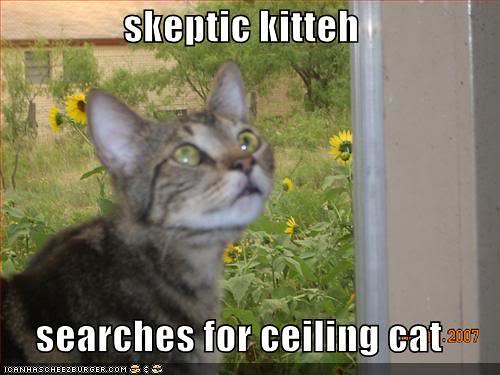



 Just after Jason, came Berkshire, who is president of the Minnesota Atheists, and has worked as vice-president for Atheist Alliance International. Berkshire explained pretty well how it is not only that it is possible to be good without God, but also, necessary to put aside the “Bible morality”, which we have been doing for quite a long time in order to achieve progress. In other words, morality doesn’t come from God, but from our own conscience on how we value other human beings.
 Bechman is the American Atheists director, and has also served in different atheist organizations. Bechman presented many of these organizations, and how they were hostile against each other at the beginning. However, according to Bechman, George W. Bush’s first term changed that, and then those secular organizations started working with each other in order to reach a common goal. I liked this concept, especially to be considered for secular associations that are just starting to try to make some kind of impact in their communities. Certainly more would be achieved if more groups worked together.
 Judith Hand
 Speckhardt was one of my favorite speakers. He is the American Humanist Association executive director, and during the conference, he talked about the different ways we consider ourselves. According to Speckhardt, atheists, agnostics, freethinkers, humanists, secularists, brights, etc, are just ways to describe ourselves with an emphasis in that which we emphasize the most. However, we are still part of those don’t believe in a god. He added that those who consider themselves with no religion are a growing group that should and will retake the United States to its secular roots by the year 2020.


 Torpy in an officer who serves as the President of the Military Association of Atheists and Freethinkers (MAAF). Torpy spoke about the stereotype that “there are no atheists in foxholes” but according to his data, those who express no religious affiliation are almost 1 in 4. Torpy also spoke about the ideal of engaging in dialogue before taking court actions, in which dialogue is not possible anymore. Legal actions should be taken only when there is no more room for dialogue.
 Croft is a student at Harvard who talked about the atheist movement’s lack of symbols and traditions, which religion has lots of, and by lacking those, the atheist movement loses the kind of people who likes them. Croft pointed at a Cross and demonstrated how many emotions and ideas come associated with it, but that doesn’t happen very often with the atheist movement.
 Kirkhart serves as vice-president for the Secular Coalitoin of American, as well as serving as co-presiden for Atheists United. Kirkhart presented many prominent female activist within the secular movemente, proving false the idea that atheism is a field only for men. Kirkhart especially mentioned Ayaan Hirsi Ali and Dr. Eugenie Scott.
 Cox was another of my favorite speakers. He talked about his experience undercover in religious groups that pretend to cure homosexuality through different therapies, which go from the utterly ridiculous, to the cruel and perverse. One of these therapies consisted of a man being touched, in a non-sexual way by other men, to provide the “manly love” in a good way that they supposedly lacked during their first years.
 Gleason organizes “Backyard Skeptics in Orange County. It’s interesting to see a community of skeptics well formed and that provides a socializing place for non-believers in a certain area. Religion provides that sense of belonging to a community (in the same way a stamp-collecting club does) and it’s certainly a good idea for non-believers to have that too.
 Nygard is a film director and producer who presented his last film trailer, “The Nature of existence”, in which he travels around the world asking different people about the reason of our existence. Preachers, priests, Buddhists, Richard Dawkins and even wrestlers give him their opinion.
 Faircloth is the very eloquent director of the Secular Coaliton of America, an also, ex congressman for Maine. Faircloth gave a pretty funny speech about how religious thinking hijacks legislation and morality, especially portraying sexuality as a big taboo and usually making things worse than they are. He also talked about how religion usually is in the way of human rights.
 14. Brian Keith Dalton, a.k.a. Mr. Deity
 With Mr. Deity and wife
 Newdow is an awesome guy. He graduated as a doctor, and then went to study law. After becoming a lawyer, he started suing against the references to God in the Pledge of Allegiance. Newdow arrived wit his family to receive the Phil Paulson Award for all he has done for a more secular. Instead of giving an award speech, Newdow sang a song, accompanied by Dan Barker. This could be called, The Separation of Church and State Song
 As a grand finale, we had Jamy Ian Swiss, a magician and skeptic activist who through his tricks showed us how easy is to fool people. Swiss said that mediums, palm readers and other alike use the same methods, which are certainly not supernatural, to take advantage of their victims, usually when they are the most vulnerable.


 Look at the far right. That was the problem
 Don't laugh! They are praying!
 This is Viracocha. He came out from the Titicaca Lake, created everything (but don't ask how the lake was already there, it's disrespectful) and then made mankind by breathing into stones. He didn't like, destroyed them with a flood and created new ones. Then went away. Nice story, isn't it?


