I like to think humanity has reached a consensus in which we understand that each person is his/her own master and can take the decisions that seem better for their lives. But then, even with the politically correct multiculturalists trying to convince us of the contrary, religious hordes bring us back to reality, a reality almost taken from the dark ages.
"What I want to say with these photos is, 'Girls, we don't have to live according to the rules imposed upon us,'" Sahin told Playboy.
However, the idea seems to only have reached a few, since her conservative Muslim family didn't take it very well. Furthermore, the Muslim community in Germany (where Sila lives and works as an actress) felt outraged that a young woman would want to break free from their customs.
Sila says ""For years I subordinated myself to various societal constraints. The Playboy photo shoot was a total act of liberation." After breaking those constraints, she was treated as a pariah by her family. Such a nice family and culture, right?
This is what happens when a group of people, inspired by their religion, bases its honor between its women's legs. Their bodies belong to anyone but them, and very frequently those who are supposed to help and support them, end up being part of the problem.
The muslim community's opinion goes from accusing her of "shaming Muslim womanhood" to branding her as a prostitute. Some even warn her to "be careful". And the Islamic Community of Germany has called for a boycott to her show,
She said: "I have always abided by what men say. As a result I developed an extreme desire for freedom. I feel like Che Guevara. I have to do everything I want, otherwise I feel like I may as well be dead."
Sila looks happy. Maybe it's just great acting, but it's pretty evident that what she did was becase she desired to. But when we talk about a religion that inspires a culture of repression and submission, those desires are subjected to anacronic laws and customs that nowadays, no matter how much liberals cringe, are pure bullshit.
Certainly there are many who practice the Muslim religion with respect for others and living good lives. But there are others who, in the name of that same religion, commit the worst atrocities. And both groups claim the others are the fake Muslims. Moreover, in places where Islam rules, human rights, especially women's and gays' are usually threatened. So we can't actually talk about just a group of people, but instead, entire societies in which the status quo keeps women one step backwards.
By getting naked, Sila doesn't harm anyone, only to those who just like to feel offended when something doesn't go according to their whims. It's pretty much like the spoiled child that cry when its parents don't do as it wishes, and in this case, Islam is the child and multiculturalism is its loving but misguided and irresponsible parent. If we criticized Islam as much as we do with Christianity, the reality would be different.
Finally, if you want to see for yourself Sila's picture, you can visit my friend Shigure's blog. You won't be disappointed.
Holy Week supposedly ends with a great event, the (supposed) resurrection of Christ. I'll do the same. I'll finish this week of recommendations with a blast. You must already know about it and maybe you have already seen it. Well, it's only fair to watch it again.
On August 27, 2009, Penn & Teller's Bullshit made an episode about the Vatican. As you can expect from them, they didn't have nice things to say. But they hard true things to say. Not a truth that is said to be given by God through the Pope, or found in the Bible. "Truth" as in facts.
The interesting thing is that this episode is not listed on Penn & Teller's webpage, nor available on the DVDs. Why could that be? You tell me, who wouldn't want that episode available to anyone?
Fortunately the internet has made a miracle. We can watch the episode about the Vatican! Whoever didn't want this to be available can't be very happy about it, just like those who oppose to sharing information are when knowledge is made available to people.
These are parts 2 and 3. They have Spanish subtitles. So, if you can, please, send them to your Spanish-speaking friend, to that foreign student, to the lady who cleans your home, or to the guy who takes care of your garden. I write most of this blog in Spanish because I feel like the Spanish-speaking world needs to have this kind of knowledge.
So far I've recommended various films and even a TV series that somehow deal with religion. Today I'll go for something more precise that doesn't have to be interpreted or understood and that leaves no room for interpretation. A documentary that lays well-deserved waste on the filth within the Catholic Church.
"Deliver Us From Evil" explores several cases of people who were abused as children by Father Oliver O'Grady during a period of 20 years. As hard as that might be, the victims, now grown up and with lives of their own, recall those experiences that might be shared by many others who don't have the courage to come out and tell the world. Maybe courage isn't the word, because I can't even imagine how disgusting such experience might be. Father O'Grady, a respected member of the community abused children put under his care by well-meaning, but deluded parents.
However, the outrage won't stop there. Many times we have heard that these are just "isolated cases" and that just one bad priest doesn't have to be the cause to blame the whole church. Well, consider that O'Grady was protected by his superiors, moved from parish to parish when some report of abuse came out. It wasn't until too many victims came out and spoke that he was brought to justice. Just until the end his superior decided to act against one of their own. Forget the children's suffering, for the Catholic Church first and most important is to keep their good reputation.
This is the kind of film that should be screened in every school, so that parents are aware of the kind of people that an organization that relies on obedience and near-veneration respect can produce. Trust is to be gained, and to talk about God is never a way to do so.
Just like with anything out there, there are lots of bad stuff, some good ones and few great ones. When it comes to Japanese animation, Neon Genesis Evangelion is the best of the best.
From it’s opening theme to the controversial and nerve-wrecking plot, Evangelion appeared during the mid 90s and became a breaking point in animation. We know the Japanese don’t make their cartoon only for kids, but for anyone who wants to be bombarded with a blast of imagination without being bounded by reality. Evangelion pushes that concept to the limit.
Evangelion has 26 episodes for TV and 2 movies, which, depending on who you ask, could be a real finale, or another look at the end we were already told. And by finale, I mean it. With the final episode (or movie) in Evangelion, the world ends. There is nothing more. Or maybe there is, but not as we know it. So, let’s take a look at one of the greatest, if not the greatest piece of animation ever made.
In the year 2015 the Earth is devastated by what is knows as “The Second Impact”, a disaster of cataclysmic proportions that destroyed Antarctica and killed half the world’s population. A 14-year old biy, Shinji Ikari arrives to the city of Tokyo 3 after being called by his father. After arriving, he will witness a huge monster being attacked by civilian forces and finally stopped momentarily by a bomb. After being rescued, he is taken to the Nerv, where his father is commander in chief.
Sachiel, the third angel
In Nerv, Shinji finally meets his father after several years. But also, he learns the harsh reality. The monsters that are attacking the city are angels send by God to produce the “Third Impact” and move forward to another reality. Eventually we will learn that to do this, they have to fuse with Adam, the first angel, who is being held captive in embryonic from by Nerv.
Adam, the first angel
Lilith, the second angel, is held captive in Nerv's headquarters
Furthermore, Shinji has been summoned to serve as a pilot for the Evangelion, giant organism made with Adam’s angelic DNA. These Evangelions lack a soul and Shinji, as well as the other Evangelion pilots, will have to serve as such.
The Eva 01
The battles are quick, bloody and breath-taking, enough to gather a huge legion of fanboys. Add to that the deep psychological processes between the different characters, from the loud and arrogant Asuka, to the silent and almost autistic Rei, both also Evangelion pilots. Every battle will take a mental toll on the characters, to the point in which an inevitable fate will come to occur, for better or for worse.
The idea that God wants to destroy his creation to “improve it” is not a new one. Having already destroyed its creation with a flood, this time God starts sending his angels with a specific purpose and it’s up to us, humans, to stop them.
Personally, I have to admit that Evangelion played a key role in my questioning of the beliefs I once had. The different interpretations of Christianity and its lining along other beliefs, even as part of a cartoon show, made a crack in what I once thought was rock solid. If there is only one cartoon you should ever consider to watch, that cartoon is Evangelion
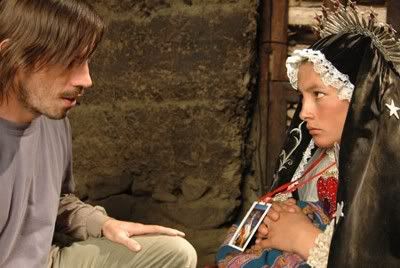
It’s interesting how the religious will usually look for a way to go around their prohibitions to do what they want, while at the same time, keeping the consciences at bay. God will always be an excuse for capitalism, socialism, bigotry, love, acceptance, racism, etc. This is the idea I got after Madeinusa, a Peruvian movie starring one of its greatest actresses, Magaly Solier
Madeinusa is a young girl who lives with her sister and her father, who is the mayor of Manayaycuna, their town, which is getting prepared for the Holy Week festivities. Salvador, a young man from the coast, arrives, apparently, to work on a mining project. He sees one of the festivities, in which several girls from town compete on who will be the Virgin Mary for the procession. Madeinusa wins and Salvador takes a picture of her. Because of this, he is locked up, being told that the villagers don’t like foreigners.
Yeah, I'm the Virgin. But won't be for very long
In town, Madeinusa acts like weeping Virgin Mary who goes along a statue of Jesus Christ who just died on the cross, towards a church. After that, the whole town celebrates because God is dead and for 3 days won’t see what they do.
Salvador: "So, let me get this straight: On Good Friday, God dies and therefore can't see all the sins you will commit?"
Madeinusa: "Let's have sex! NOW!"
Salvador breaks free and starts walking around town. He then meets with Madeinusa, who proceeds to seduce him and finally having sex with him. Madeinusa then asks him to take her to Lima, the capital in the Coast. Salvador refuses and she goes away, angry.
Madeinusa: Ok, we had sex, now take me out of this town
Salvador: You bitch...
At night, when one of the town’s women is taking Madeinusa clothes off, she notices blood and realizes she is not a virgin anymore. She goes and tells her father, who takes her home. When Salvador goes by their house, he hears people having sex.
The next day Salvador wakes up drunk and is guided to a weird ritual in which some women are choosing men to have sex at night. Salvador leaves, disgusted. At night, the mayor takes him to the second floor of his house, and he shows him all the offerings the people have given to the church. Madeinusa is also there. He then tells Salvador that he can take anything and go back to Lima. Salvador refuses and leaves, and the mayor then leaves Madeinusa locked up. However, she escapes and goes to Salvador, who finally agrees to take her to Lima. They are leaving, but at night, she remembers she doesn’t have her mother’s earrings. She comes back and finds that her father has broken them.
Madeinusa waits for the morning and prepares soup for her father, but it is poisoned. Salvador comes back, looking for Madeinusa, but find the mayor, dead. Madeinusa’s sister arrives and thinks he killed her father and starts calling for the people.
At the end, we only see Madeinusa in a truck going to Lima, without Salvador. His camera is seen lying among the Holy Week offerings.
Then she moved to France
Some people criticized the movie because, they said, it depicted villagers from the Peruvian mountains as crazy people, while the one arriving from the coast is the civilized one. This however is an impression one can have, especially if it’s the first time one lives through local celebrations. Usually during these celebrations, there is great display of religiosity, but also men and women get drunk, there is violence and some people get injured.
This is a nice depiction of the religious hypocrisy that is lived through ritual that are respected simply because tradition is an unmovable force in such places. Traditions and customs are respected, especially if they have some religious meaning, and under that excuse, people will do whatever they want. It doesn’t matter if you got drunk, hit your wife or had a child out of wedlock, if it was during the saint’s celebration, it’s all ok.
La inquisición fue uno de los períodos más oscuros del cristianismo, y si bien la mayoría de esto ocurrió en Europa, los jóvenes Estados Unidos no fueron inmunes a esta locura religiosa. Uno de los episodios más prominentes fueron los juicios de Salem, los cuales fueron adaptados para el cine en "The Crucible" o "Las Brujas de Salem"
En Salem, Massachusetts, un grupo de chicas y una esclava de Barbados bailan alrededor de una fogata en lo que parece ser un rito pagano. Abigail (interpretada por Winona Ryder) bebe la sangre de una gallina mientras desea que la esposa de John Proctor muera. Uno de los hombres del pueblo las ve y las chicas escapan, pero una de ellas se desmaya. Al regresar al pueblo, la chica no despierta y el resto empieza a ser interrogada sobre lo que pasó. Entre los que acuden a la casa de la chica enferma se encuentra John Proctor, quien había tenido un affair con Abigail.
Algunos de los hombres piensan que las chicas solo están simulando estar enfermas, pero otros, incluyendo el reverendo, creen que están poseídas. Las chicas acusan a la esclava de trabajar con el demonio y escapan el castigo.
Lo siento, pero en este tiempo los negros siempre tenían la culpa de todo
Dándose cuenta de lo fácil que es acusar a alguien de brujería, las chicas empiezan a acusar a otras mujeres en el pueblo, entre ellas a la esposa de John. Las acusadas son arrestadas, pero la sirviente de John, quien también había estado entre las que habían simulado no despertar, es instada a declarar que todo era una mentira. Ante la posibilidad de ser acusadas de mentir al jurado, las chicas acusan a la sirvienta de John de ponerles un hechizo. John entonces confiesa el haber tenido un affair con Abigail y es por eso que ella quiere deshacerse de su esposa.
El jurado le pregunta a la esposa de John si eso es cierto, pero esta lo niega, tratando de defenderlo. Más aun, la sirvienta de John lo acusa de trabajar con el demonio, por lo que John y su esposa son entonces encarcelados y sentenciados a morir.
Abigail trata de escapar, pero antes le pide a John que vaya con ella. John se niega. En la víspera de su ejecución, el juez le ofrece a John el declararse culpable y evitar la pena de muerte, pero John elige morir y conservar su nombre limpio.
Lo más saltante y obvio de esta película es lo fácil que gente que se supone inteligente, bajo el influjo de la religión, puede creerse cualquier cosa y, lo que es peor, dañar a inocentes sin más prueba que sus propios prejuicios. Más aun, este fanatismo puede ser fácilmente manipulado incluso por unas chiquillas para escapar de un castigo.
La presencia del ritual pagano también saca a la luz algunas preguntas, como lo poco dispuestos que estaban los habitantes de Salem a tolerar otras expresiones religiosas. Ojalá pudiera decir que eso fue en aquella época, pero aun hoy vemos bastantes actitudes de ese tipo entre aquellos que se dicen devotos del Señor.
Afortundamente, los días de cacerías de bruja ya no están y ahora las brujas son muy bien vistas
Si les gustan las películas con un contexto histórico, no duden en conseguir esta. Y más aun, pueden buscar el libro original e investigar la historia de Salem. Material hay bastante.
The inquisition was one of the darkest periods of Christianity, and while most of it occurred in Europe, the newly founded United States was not free from religious fanaticism. One of the most prominent episodes of such craze was the Salem witch trials, which were adapted in The Crucible.
In Salem, Massachusetts, a group of girls and a Barbadian slave dance around a fire like celebrating some kind of rite. There, Abigail (played by Winona Ryder) drinks a chicken’s blood and wishes for John Proctor’s wife to die. One of the town’s men sees them, and surprises them. As most of the girls flee, one of them drops unconscious. The girl won’t wake up and the girls that were seen are questioned about what happened. Among those who arrive at the sick girl’s house, is John Proctor, who had an affair with Abigail.
Some of the men think that the girls are just pretending to be asleep, but others, including the town’s reverend, believe that they are possessed. The girls accuse their slave to be working with the devil and escape the punishment.
Sorry, but in this time, the blacks always get blamed for everything
Aware of the easiness of accusing someone to be witch, the girls start accusing other women in town, John’s wife among them. The accused are arrested, but John’s servant, and one of the girls who wouldn’t wake up, is asked by him to testify that the sickness was faked. Facing the possibility that they might be accused of lying to the jury, the girls accuse John’s servant of being a witch and put a spell on them. John then confesses to having an affair with Abigail and the reason she is doing all this is to get rid of his wife.
John’s wife is asked if it’s true that her husband had an affair and she lies trying to protect her husband. Moreover, John’s servant accuses him of working with the devil. John and his wife are then apprehended and sentenced to be hanged.
Abigail then tries to escape and asks John to come with her, but he refuses. John is the offered to confess of working with the devil and be freed. However, he chooses to die while keeping his innocence.
The obvious idea we get from this film is how easily people who are supposed to be intelligent, under the spell of religion, will believe anything and, which is worse, harm others without any proof further than their own prejudice. Moreover, this zealotry can be used just like the girls used it against innocents, just to escape their punishment.
The witchcraft ritual also spawns some questions, especially how intolerant of other religions the early Americans could be. It would be nice if this were only at that time, but unfortunately, nowadays we see the same behavior among those who claim to be faithful to the Lord.
But those days are gone and now witches are awesome
If you like historical movies, check this out and then you can get the book or research more on the issue.
The movie is based on a novel written in 1875, which means that priests haven’t been that holy for a long, long time. If they ever were. "The Crime of Father Amaro" was nominated for best foreign movie.
Father Amaro (played by Gael García Bernal) arrives to a small town in Mexico, where he is sent to learn from the elderly priest in charge. He starts celebrating mass and is admired by the extremely Catholic inhabitants, especially by Amelia, a young woman who teaches catechism to the children. Amaro soon notices that the older priest has an affair with Amelia’s mother, but says nothing. He also says nothing about the construction of a hospital that is financed by drug money.
"You will go to heaven, but there is room for only one Virgin there
On the other side, there is another priest who is criticized for helping a leftist guerrilla. He eventually will get defrocked, but will continue to help the insurgents.
Having feelings for Amaro, Amelia dumps her boyfriend Ruben, a journalist and an atheist who has proof about the relationship between the church and the area drug lord. He writes an article for the local newspaper, but the church threatens it with withdrawing their advertisements from the newspaper. Ruben is fired and then his home vandalized by angered Catholics and his father results injured
Not even God can escape this temptation
Amelia announces she is pregnant with Amaro’s child. Despite the words about love being a blessing, Amaro refuses to acknowledge that he is the father, since that would threaten his career as a priest. Amelia asks Ruben to marry her, but he refuses. Amaro then arranges for Amelia to have an abortion. At night, he takes her, along with a devout catholic woman to a clinic, but she starts bleeding profusely. Amaro tries to get her to a hospital, but she dies in the way.
Days later, Amaro celebrates mass, while the town thinks that Ruben was the one who impregnated Amelia and Amaro saved her.
Oh, yeah, thank you guys for blaming the atheist. Now come and keep drinking the cool-aid.
The depiction of the admiration the people feel for their priests (“Father Amaro is a living Saint”) is a great reflection of reality, a reality in which people, especially poor and uneducated, tend to blindly trust their priests, pastors, and in general, anyone who claims to represent God. A sad reality that ended up in thousands of children being abused.
Another thing worth noting is that among the “bad” priests, there is a good one who chooses to serve where he is needed. More than trying to patch the Catholic Church’s reputation, I think this represents pretty well that those who get the most recognition aren’t usually the best ones when it comes to “serving God”.
There is also the fact that Amaro feels guilty for what he does, at least at first. But then, he finds a way to reconcile his conscience with his priestly duty and then keep doing what he does, meaning, Amelia. At least this time it was a willing young woman instead of a boy.
Finally, the people’s zeal about defending their priests against those who criticize them depicts pretty well the kind of sheep religion breeds.
Overall, The Crime of Padre Amaro is a great drama that will have viewers, both believers and non-believers entertained and outraged. And maybe, might make some believers rethink their ideas about priests, pastors and other snake-oil dealers.
If you live in a place with a Catholic majority, you have to live with the Holy Week. This is the week that precedes Easter (when Jesus came back to life and became a zombie) and should be of preparation for such an important date (even though it's not a fixed date and changes depending on the lunar calendar (Pagans called, they want royalties for using their way of choosing dates for their rituals).
This is a Holy Week celebration in Spain. Yes, I know it looks like something else.
Regardless of how it started, the problem is that everything around smells like incense and over-the-top holiness. But not everything is really that bad. I remember, as a schoolkid, I loved holy week since we got 2 days off (Good Thursday and Friday). Had I known that kids in the United States got the whole week off with a less pretentious name (Spring Break) it would have been really pissed off.
Another thing I had to live with was that locals TV stations would broadcast biblical films and cartoons. At that time I enjoyed them, I think because those were once-a-year films. Nowadays it's not funny anymore.
So if you live in that kind of environment, you might want to watch something less preachy. During these week I'll be updating daily with recommendations to have an entertaining and sane Holy Week.
Today's recommendation is Chocolat:
A woman and her daughter arrive to a conservative French town, desiring to open a candy store. The villagers get intrigued during the time she makes the preparations and when she does, some arrive, curious to know what she has to offer. The problem is, she opened her candy store during lent. And the conservative major (played by Alfred Molina) cannot accept that people might have some kind of pleasure (like eating delicious chocolate) during a time that is supposed to be of suffering.
At the same time, a group of gypsies (led by Johnny Depp) arrives to town. They set camp at the riverside, since they are usually shunned by the townspeople. However, they get along pretty well with the chocolate store owner, which infuriates the major and some other conservative villages even more, to the point of burning down their camp.
What? You are an atheist who doesn't celebrate catholic rituals and sells chocolate? I'll crush you to death!
It's interesting how the protagonist is hinted to be an atheist. But more interesting is how her actions, while not disregarding of the village traditions, are viewed as threatening to the town's morality. While wrapped in a comedy/drama/romance format, it reflects very well how many believers feel about others who won't share their delusion or traditions.
So, go to the rental store, ask a friend, or get it from the internet (you know how, right?), this is a very nice film who would slip well as a family movie.
En las primeras páginas de “The God Delusion”, Richard Dawkins cuenta cómo el capellán de su escuela, durante su niñez, se encontró repentinamente sorprendido al notar la complejidad y maravillosa realidad en la que se encontraba inmerso, acostado en un campo, rodeado de naturaleza. Dawkins nos presenta a este capellán, al que llegó a admirar, en muy buenos términos. Y es que muy a pesar de la fuerte postura atea de Dawkins, parece admitir que llega a reconocer el bien en aquellos que ven la maravilla que es la naturaleza que nos rodea.
Ciertamente, una maravilla
Como dije el año pasado en esta misma fecha, Richard Dawkins es una figura polarizante incluso dentro del movimiento ateo, si es que se le puede llamar así. Su “ateísmo militante” parece alejar a muchos liberales que prefieren vivir en un mundo políticamente correcto para no ofender a las religiones y culturas que se verán prontamente ofendidas cuando alguien (como Dawkins) empieza a hacer preguntas incómodas. Y ni qué decir de los conservadores que ven en Dawkins a u agente de un liberalismo secular que amenaza con quitarle el poder a las elites enquistadas en el poder a través de la iglesia, en cualquiera de sus formas.
Dawkins incluso goza de cierto desagrado entre ateos tanto o más militantes que él mismo. Desde los que lo critican por no ser condescendiente con los religiosos moderados, hasta aquellos que lo critican por presentarse como un “mesías” del ateísmo, pasando por los “revolucionarios” (especialmente en Latinoamérica) que no pueden ver nada que les recuerde que un hombre blanco pueda ser líder de algo.
Pero aun así, es innegable que al deshacernos de las consideraciones y las penas por religiones y culturas, las palabras de Dawkins usualmente tienen sentido, especialmente si buscamos un mundo en el que prime la razón y el espíritu de investigación. Dawkins podrá ser muy áspero cuando se refiere al fenómenos religioso, pero antes de indignarnos por su falta de reverencia, es necesario notar qué es lo que la provoca. Por lo general, lo hace un desprecio a la ciencia como método para conocer mejor el mundo que nos rodea, a favor de mitos que, aunque falsos, hacen felices a muchos. O sino también, la separación de individuos debido a diferencias religiosas que no tienen más base que la costumbre y tradición que impide a muchos avanzar hacia un futuro mejor para todos.
Eso es lo que hace a Dawkins, una persona admirable.
Hoy Richard Dawkins cumple 70 años y como es natural, puede morir en cualquier momento. Por mucho que lo admire, no me voy a engañar pensando que será eterno, o que en sus últimos años no podrá soltar uno que otro disparate. Sin embargo su legado es uno de razón y unión de la raza humana, pero no en base a un ser superior que nos ordena hacerlo así y que no admite cuestionamientos, sino en base a el conocimiento que hemos adquirido y seguiremos adquiriendo.
A couple of weeks ago (damn, it’s taken me so damn long to write this) the Southern California Secular Humanist Conference took place in San Diego. Well, this is kind of a long name for an atheist conference, but the idea, I guess, is to reunite all forms of lack of belief, and since today “atheist” is still sort of an alienating term, we have “secular humanist”. But that’s just a minor detail. I’m glad I went and had an awesome time.
My principal motivation to go was to meet Dan Barker. As most of you know (or should know), Barker was an evangelical preacher who even used to go to Mexico to convert Catholics into Protestants. However, one day he started to question his beliefs and after some time, he came out as an atheist. Today, he works for the Freedom From Religion Foundation.
Jason Frye Kolarik The conference started at 9 a.m. with a little introduction by Jason, who was the main organizer and one of the most powerful promoters of the atheist movement in the San Diego area. Jason works as president of the Humanist Association of San Diego and also as a “humanist minister” which means he acts as a minister in events that otherwise would need a priest or a pastor.
Just after Jason, came Berkshire, who is president of the Minnesota Atheists, and has worked as vice-president for Atheist Alliance International. Berkshire explained pretty well how it is not only that it is possible to be good without God, but also, necessary to put aside the “Bible morality”, which we have been doing for quite a long time in order to achieve progress. In other words, morality doesn’t come from God, but from our own conscience on how we value other human beings.
Stuart Bechman Bechman is the American Atheists director, and has also served in different atheist organizations. Bechman presented many of these organizations, and how they were hostile against each other at the beginning. However, according to Bechman, George W. Bush’s first term changed that, and then those secular organizations started working with each other in order to reach a common goal. I liked this concept, especially to be considered for secular associations that are just starting to try to make some kind of impact in their communities. Certainly more would be achieved if more groups worked together.
Judith Hand Hand is an ethologist and peace activist who talked about humanity’s goal for global peace, but from an evolution point of view. According to hand, since there have been movements to erradicate slavery and child labor, eventually we can make a movement against war, which is some kind of “evolutive defect”. Also, Hand is a prolific writer with many published books.
Roy Speckhardt Speckhardt was one of my favorite speakers. He is the American Humanist Association executive director, and during the conference, he talked about the different ways we consider ourselves. According to Speckhardt, atheists, agnostics, freethinkers, humanists, secularists, brights, etc, are just ways to describe ourselves with an emphasis in that which we emphasize the most. However, we are still part of those don’t believe in a god. He added that those who consider themselves with no religion are a growing group that should and will retake the United States to its secular roots by the year 2020.
And this goes along pretty much with how I see the atheist/secular/humanist/whatever movement. No matter what my purpose is, (which nature Dan Barker would later explain) is to contribute to build a better world for everyone, a world in which religion doesn’t mess with anyone’s life. To be involved in petty fights over what label we are using is just useless. Considering what Bechman said, atheists need to be organized and work together, more and better than what we are doing, in order to achieve our goals.
Debbie Skomer Skomer wasn’t exactly a speaker, but the receiver of an award, the Local Organizer Award, for all she did representing the secular humanist community in San Diego, especially regarding talking to the press.
Dan Barker As I said before, meeting Dan Barker was my main motivation for coming to this event. I had considered even going to Mexico for the Coloquio de Ateismo, but didn’t have my passport ready. So, as soon as I got to the conference I looked for him. There he was, talking to other like he was another one of us, not a renowned atheist activist. He was very nice and got to talk to him, even doing an interview in Spanish, for all the atheists who can relate to his story of leaving his faith after being a committed believer, me among them. I also bought a couple of his books, The Good Atheist (which is about our purpose in life) and Godless, which is about the journey from religion to reason. There is also an older book "Losing Faith in Faith: From Preacher to Atheist" which didn't seem to be available with Barker at that moment.
En su presentación, Barker hizo gala de sus dotes como músico, y nos cantó ya no una canción que hablara del amor de Dios y otras patrañas, sino de algo más animado y menos irracional.
After the songs, he talked about our purpose, which is the topic on his last book. Barker said that people have to find their own purpose in life, which usually involves fixing something they see unfit for the world. This purpose should be determined by the person and definitely not be thought as given by God, or more exactly, by anyone claiming to know what God wants from us.
As I said before, I can pretty much feel identified with Barker. I once was a devote believer and had no doubt that there was something God wanted from me. Happy I was, but delusional nonetheless. I’m happy I’m not in such state anymore and the only intolerance I can harbor goes toward intolerance itself.
David Diskin David Diskin is the organizer of Camp Quest West, which is a summer camp that, unlike many other around the US has no religious affiliation. The idea is not teach atheism to the kids, but to teach them how to reach answers with the correct tools. Certainly something very different from religious oriented camps, like this one:
Jason Torpy Torpy in an officer who serves as the President of the Military Association of Atheists and Freethinkers (MAAF). Torpy spoke about the stereotype that “there are no atheists in foxholes” but according to his data, those who express no religious affiliation are almost 1 in 4. Torpy also spoke about the ideal of engaging in dialogue before taking court actions, in which dialogue is not possible anymore. Legal actions should be taken only when there is no more room for dialogue.
James Croft Croft is a student at Harvard who talked about the atheist movement’s lack of symbols and traditions, which religion has lots of, and by lacking those, the atheist movement loses the kind of people who likes them. Croft pointed at a Cross and demonstrated how many emotions and ideas come associated with it, but that doesn’t happen very often with the atheist movement.
Bobbie Kirkhart Kirkhart serves as vice-president for the Secular Coalitoin of American, as well as serving as co-presiden for Atheists United. Kirkhart presented many prominent female activist within the secular movemente, proving false the idea that atheism is a field only for men. Kirkhart especially mentioned Ayaan Hirsi Ali and Dr. Eugenie Scott.
Ted Cox Cox was another of my favorite speakers. He talked about his experience undercover in religious groups that pretend to cure homosexuality through different therapies, which go from the utterly ridiculous, to the cruel and perverse. One of these therapies consisted of a man being touched, in a non-sexual way by other men, to provide the “manly love” in a good way that they supposedly lacked during their first years.
Bruce Gleason Gleason organizes “Backyard Skeptics in Orange County. It’s interesting to see a community of skeptics well formed and that provides a socializing place for non-believers in a certain area. Religion provides that sense of belonging to a community (in the same way a stamp-collecting club does) and it’s certainly a good idea for non-believers to have that too.
Roger Nygard Nygard is a film director and producer who presented his last film trailer, “The Nature of existence”, in which he travels around the world asking different people about the reason of our existence. Preachers, priests, Buddhists, Richard Dawkins and even wrestlers give him their opinion.
Now, at some break, an awesome piece of music came from the speakers. I went and asked the sound guy what was it, and he told me to ask the group who was performing, Ana Kefr, which is a metal band with an atheist theme. I went to them, bought their CD and told them they were awesome.
Sean Faircloth Faircloth is the very eloquent director of the Secular Coaliton of America, an also, ex congressman for Maine. Faircloth gave a pretty funny speech about how religious thinking hijacks legislation and morality, especially portraying sexuality as a big taboo and usually making things worse than they are. He also talked about how religion usually is in the way of human rights.
A really nice guy.
14. Brian Keith Dalton, a.k.a. Mr. Deity I don’t think there are many atheists who don’t know who Mr. Deity is. In case you don’t, well, Mr. Deity is an absent-minded deity (maybe God) that doesn’t seem to get what is wrong with his commandments and the way his people behave, even seeing nothing wrong with they stoning a woman for not being a virgin, or wiping entire towns..
Dalton made a comparison between holy books and cooking books, both of which take their followers to accept only one way to cool food and leading to disputes and violence.
With Mr. Deity and wife
15.Michael Newdow Newdow is an awesome guy. He graduated as a doctor, and then went to study law. After becoming a lawyer, he started suing against the references to God in the Pledge of Allegiance. Newdow arrived wit his family to receive the Phil Paulson Award for all he has done for a more secular. Instead of giving an award speech, Newdow sang a song, accompanied by Dan Barker. This could be called, The Separation of Church and State Song
Newdow was sitting in front of my table, along with his wife and two daughters. If I ever have children I would like to be as cool dad as Newdow is.
16. Jamy Ian Swiss As a grand finale, we had Jamy Ian Swiss, a magician and skeptic activist who through his tricks showed us how easy is to fool people. Swiss said that mediums, palm readers and other alike use the same methods, which are certainly not supernatural, to take advantage of their victims, usually when they are the most vulnerable.
I couldn’t record his presentation, since we had been explicitly told that nothing could be taped. If I weren’t a skeptic and Swiss would be making the case of having supernatural powers, I might have believed him. He got to know a word picked by a random person from a random book, with minimum details. Truly impressing stuff.
And that was it. After that I helped picking up some cables and joined other for the after party at the bar in the hotel. Faircloth was there, as well as James Croft and Jason Kolarik. I’m really glad I went to this conference and just sad it took me so long to write all this.
History is full of episodes in which people of faith have thrown away every ounce of tolerance and acted violently against those who won't conform to their (usually) nonsensical beliefs. Today I got to see Hypatia's story as depicted in Agora.
I won't bother in demonstrating that the way Hypatia's death is portrayed is accurate. It's not. The movie takes some liberties when portraying her life and death. Look at her. Cute, right? Well, I seriously doubt the real one looked like that. But the underlying idea of the movie and events show us a deeper, undeniable truth.
Many have said this is an "anti-christian" movie, some sort of "anti-Passion of the Christ". It's not. It's a depiction of how blind faith no matter what name it receives, pushes self-righteous people to become monsters, and how precious is a mind that considers others as equals, and how such mind is a threat to the hierarchical religious thinking.
The movie starts with a tension between Christians and Pagans, the latter starting hostilities. Hypatia is a pagan philosopher who teaches at the library and pleads for peace, but is not heard. Therefore, the Pagans attack the Christians, but these retaliate, taking control of the library, destroying all the works inside since they are seen as "heretical". After that, they would gain control of the city, banning Pagan and Jewish cults.
Something remarkable is that Christians are not the only ones who are represented as violent. All the other groups do so, in every case because of feeling insulted by the mere presence of other faiths.
Among all this turmoil, Hypatia tries to discover the path celestial bodies follow. She considers other explanations, she experiments, and questions her own knowledge, finally arriving to an answer.
That something Christianity (or the other faiths) would not do.
Hypatia is like a Sun, trying to shine for a better cause than the petty and idiotic fights between those who surround her. In the end, she is killed as a result of her knowledge being threatening to the power Christianity tries to obtain. Just like the dogma that the Earth was the center of the universe, Christianity tries to be the center and most important thing in the universe.
Another remarkable part is when one of the Christians starts to question his faith, saying that they are not behaving like Christ, who forgave those who killed him. That's a nice attitude, and certainly, if more Christians, or those who are in power, had that attitude, the world would be different. But that is not the case.
God won't come down to tell us what he really wants. Jesus is not coming back. The only thing we have are the many different interpretations that twist scriptures as they want. Moreover, scripture being so cryptic and full of nonsense, it becomes really useful when it comes to shut minds down, forsake critical thinking and attack possible threat to the desired absolute power.
Hypatia was a woman whose knowledge offended Christians and threatened the control they desired. It still does. I wonder how many Hypatias are out there. Her life is that of a woman who gave up the customs of her time and made the brave bet for knowledge and instruction. She was indeed a teacher, a sister and a mother. May there be more Hypatias and let us be those who sit and listen instead of those who throw rocks at her.
Oh, and finally, the WTF part: When Hypatia gives a piece of cloth stained with menstrual blood to the guy that had declared his love for her, in order to show him how imperfect she is. Ladies, really, a "sorry, but no" is enough.
If you are aware of how politics run in the United States, then you certainly know who Stephen Colbert is
In case you don't know, Colbert is a satirist who parodies right-wing attitudes and criticizes them. Of course, he also takes on liberals sometimes, but conservatives tend to give more material for satire. Like this:
O'Reilly is obviously a moron and Colbert awesomely points that out. The argument of "I don't know how that works, therefore God must be behind it" is just taking pride in one's own stupidity and ignorance, using the later as an excuse to believe in God.
One would thing that, since Colbert criticizes religion so hard, he would be, at least, a non-believer. O'Reilly for example, is a Catholic.
I love my Church, and I'm a Catholic who was raised by intellectuals, who were very devout. I was raised to believe that you could question the Church and still be a Catholic. What is worthy of satire is the misuse of religion for destructive or political gains. That's totally different from the Word, the blood, the body and the Christ. His kingdom is not of this earth.
The first sentence will be puzzling for many, but it shouldn't be. Yes, there are Catholics who are pretty intelligent and won't go along with much of the non-sense that comes from The Vatican. After all, Catholics aren't as crazy as Evangelicals who support Intelligent Design.
The second sentence is kind of puzzling, since the Catholic Church is certainly not a democracy. It's teachings are supposed to be those of the very institution founded by Christ and should not be criticized. To pretend to criticize it, or disobey them, sounds a little bit hypocritical. Yet, if that leads to a more open, liberal and democratic Catholic Church, then might be ok.
The last sentences have two sides that are worth mentioning. First, Colbert criticizes the use of religion for "bad" things, like gaining power or destroying others. That sounds nice. However, it's up to Colbert to make such judgment. But that's not what the leaders of the church think. That's not what the Vatican thinks. It's hatred of gays and atheists, and the destruction of life that comes along with a policy against condoms make it pretty obvious.
No religion has the monopoly of goodness, so it's wrong to assume that whatever is bad is opposed to the word of God. The Bible has been interpreted by many in very different ways, both to do wrong and right. But all of them claim to have the correct interpretation.
Finally, I like watching the Colbert Report. It's satire is impeccable. Colbert might think that there is a kingdom for the afterlife, which is ridiculous, but as long as he keeps that himself, no problem with me.
Youtube has revolutionized communications in a way it hasn’t happened in a long way. It’s power is undeniable, whether it is about cute cats, police violence or helping and underdog winning an election. Also, it is a great tool to spread knowledge, something religions are pretty weary about, since their business thrives in ignorance. There are many wonderful Youtube channels, but if I had to chose, I’ll stay with:
1. The Thinking Atheist The Thinking Atheist updates regularly with a short video with great effects and narration about something nonsensical from the Bible or another holy book or religion. Believe me, there are lots of materials. The Thinking Atheist puts lots of effort and some budget to make his videos, which are remarkable, to say the least.
2. ZOMGitsCriss With common sense and intelligence as stunning as her beauty, ZOMGitsCriss talks in front of the camera about several issues related to religions and how they affect (usually, negatively) our lives. But don’t be fooled, any effect you can put on the video wouldn’t match her attractive or sexy accent. You seriously can’t miss her.
3. Edward Current Parody never looked so real. With Edward Current you will at some point ask yourself if this guy is some atheist mimicking loony beliefs or a “True Christian”. Relax, he is not the latter, but we know there are people do and think exactly as Edward’s character.
So, if you are more "audiovisual" than "reader" take a look at this channel. Won't be time wasted.
Woe to you, oh earth and seaFor the Devil sends the beast with wrathBecause he knows the time is shortLet him who hath understandingReckon the number of the beastFor it is a human numberIts number is six hundred and sixty six
Yesterday, the blog’s Facebook page reached 666 fans. I asked the members what to do to celebrate such event and many said that nothing should be done, that number is nothing especial. They are right.
However, even though that number is just another one, it does mean something. Something that thanks, to the religious way of thinking, we all recognize. And this is not the only thing that can be perceived as evil or satanic. There are many more things that can be seen as “of the devil”, thanks to superstition and religion. If there is something that represents good (God) then there must be something that represents evil, and we have to look for that.
This is what happens with the 666. It appears in the Bible, which is supposed to be the “Word of God”, identified as the “Number of the Beast”. And that’s it. Everything that has to do with that number automatically becomes “of the Devil”. That’s the limited rationale of those who have the Bible as only guide for their lives, that everything has to have a purpose and that a number is not just a number.
This has been going on for centuries, but had a revival when “The Omen” came out in 1976.
Besides the number 666, the name “Damian” and the Rottweiler have been associated with the devil. That’s the power superstition has on the weak religious mind.
Few years later, in 1982, Iron Maiden released “The Number of the Beast.” The group had already drawn attention because of their music, their lyrics and their LPs. Given the nature of the group, it wasn’t surprising that they made a song about the “Number of the Beast”. Which was kind of surprising is that many saw them as satanic, just for a song.
Those around 40 might remember how dangerous and “taboo” was to listen to Iron Maiden. At least in my country there were many stories about outraged mothers who destroyed posters, cassettes and any paraphernalia related to Iron Maiden belonging to the teenage son.
That is how ignorance and religion play together. The song is about a nightmare one of the members had. Yet, it was only needed that it featured something described as “evil” in the Bible to be taken as evil and with a strong campaign against it.
I wasn’t born yet when “The Number of the Beast” came out, and I would be interested in it many years later. But I had to see first hand something very similar.
During the 90s there was a Dragon Ball fever in Latin America. Kids from my generation grew up along with Goku, seeing his quests, battles, friends and enemies. Goku was a good guy who fought against eveil and to be better and stronger. A real hero.
But its success also attracted the attention of several churches who, forgetting about their “Thou shalt not lie” commandment. A flyer circulated, accusing Dragon Ball of meaning “The coming of the beast”, saying that “Kakaroto” means “evil possession”, Saiyajin of meaning “Possessed by the Devil”, Kayo Ken of being some kind of evil energy. Pure bullshit, as you can see, but it was enough for many parents and teachers to declare war on the anime series. They did so without knowing exactly what was behind that on just taking as true a pamphlet claiming to be against the devil.
That is how religion works, it feeds on ignorance and fills it with false information that usually leads to suffering and hatred. The religious mind makes the persona a mindless zombie that will follow anything that has the “God” seal on it. The saddest thing is that it doesn’t limit to awesome bands and cartoons, but actually harms people.
Yes, the title is a reference to that movie that just came out, I think, last weekend. Yes, I know, it was kind of silly, but had lots of geek references that made it funny. Also, I had a cute girl with me, so it was a good time.
So, yes, I enjoyed the movie. However, the guys from CBN (Christian Broadcasting Network) didn’t
First of all, let us know who are those talking. CBN is a network founded by one of the biggest Christian assholes, Pat Robertson, who is well know for blaming Haiti’s "pact with the Devil" for the quake they had at the beginning of the year. Focus on the Family on the other hand, is an organization founded by James Dobson, which purpose is to “nurture and defend the God-ordained institution of the family and promoting biblical truths worldwide”, such as school prayer, corporal punishment, opposition to abortion, feminism, porn and gambling, and of course, demonization of homosexuality.
Ok, so we know the sponsors are world-class bigots. But let’s forget about that and pay attention to the message
The newscaster says “beware of the anti christian messages out there”. So, there must be some movies that say very clear that Christianity is a bad thing, or Christians are just mindless sheep, or stuff like that, right? Well, check it out:
Well, no. If you see what the “Plugged in” guy says, it’s all about the fact that Ramona (the main female character in Scott Pilgrim vs. the World) has had a girlfriend. Add to that, the fact that Scott’s roommate is gay.
Look at the far right. That was the problem
Apparently, that makes it unfit for 13-year olds, because, well, no 13-year old knows that gays and lesbians exist. Or, if they do, they should now that their way of loving is, wrong, evil, and, anti-christian.
I think I have stated it before, that I have no problem with people believing whatever they want to believe. The problem comes when “different” becomes “anti”; when “different” becomes the enemy. I might not care much if this were just one bigotted redneck talking in his mobile home, but that’s not the case.
We are talking about these views in a broadcasting network, with millions of people watching, founded by “respectable” members of our society, despite their bigoted and anti-scientific views. Yes, I say “anti scientific”, because, gays are not evil, Haiti’s quake had its origin in plaque tectonics and the Earth is not 6000 years old.
Then there are two other reviews that I don’t care much about. “Eat, Pray, Love” sounds like a chick-flick that doesn’t get my attention, but, by the comments of that guy, is “anti christian” because Julia Roberts tries to find the “divinity within herself”, and because it “asks the right questions” but answers them in the wrong way, meaning, not in the Christian way. Because, well, for these guys, anything that is not Christian, is anti-Christian. It’s “new agy” and that gets them worried, because someone might want to think differently. It says that we are “spiritually divine” and that is sad and scary, for these Christians. “An anti-christ message”
Please, wake me up when it's finished
Finally, “The Expendables”. Obviously, it’s not a family film, but apparently not even christian grown-ups should see it, since it receives a “thumbs down”. Maybe that “born again” thing leaves them being children forever. See how easy is for children to believe in Santa Claus, or the Tooth Fairy? Yeah, like that.